AKPK Explained: Free Debt Help and the DMP in Malaysia
What AKPK is, how the free Debt Management Programme works, who qualifies, what it does to your credit record, and when a consolidation loan is the better route.
There is a point where borrowing stops being the answer. When the minimum payments alone no longer fit, taking another loan does not solve the problem — it postpones and enlarges it.
Malaysia has a free, official service for exactly that situation, and a surprising number of people who need it have never heard of it, or assume it is a last resort reserved for near-bankruptcy. This guide covers what AKPK is, how its Debt Management Programme works, what it genuinely costs you, and how to tell whether it or a consolidation loan is the right tool for your situation.
What AKPK is
AKPK stands for Agensi Kaunseling dan Pengurusan Kredit — the Credit Counselling and Debt Management Agency. It was established by Bank Negara Malaysia in 2006 to help individuals manage their finances and, where necessary, restructure their debts.
It is not a lender, not a collections agency, and not a government handout scheme. It sits between borrowers and financial institutions as a neutral party, and its services to individuals are free.
AKPK does three things:
- Financial education — workshops, modules and materials on budgeting, credit and money management.
- Financial counselling and advisory — one-to-one sessions where a counsellor reviews your income, commitments and options with you. You do not need to be in trouble to use this.
- The Debt Management Programme (DMP) — a structured restructuring of your debts with participating financial institutions.
The middle one deserves emphasis. Many people assume AKPK is only for enrolment in the DMP. Counselling on its own — a sober outside look at your numbers before anything goes wrong — is available and is often all someone needs.
How the Debt Management Programme works
The DMP is the part most people mean when they say "AKPK". Broadly, it runs like this:
- You apply and disclose everything. Income, every commitment, every facility. Partial disclosure produces a plan that fails.
- A counsellor builds a budget with you. Essential living costs come first; what is genuinely left is what can service debt.
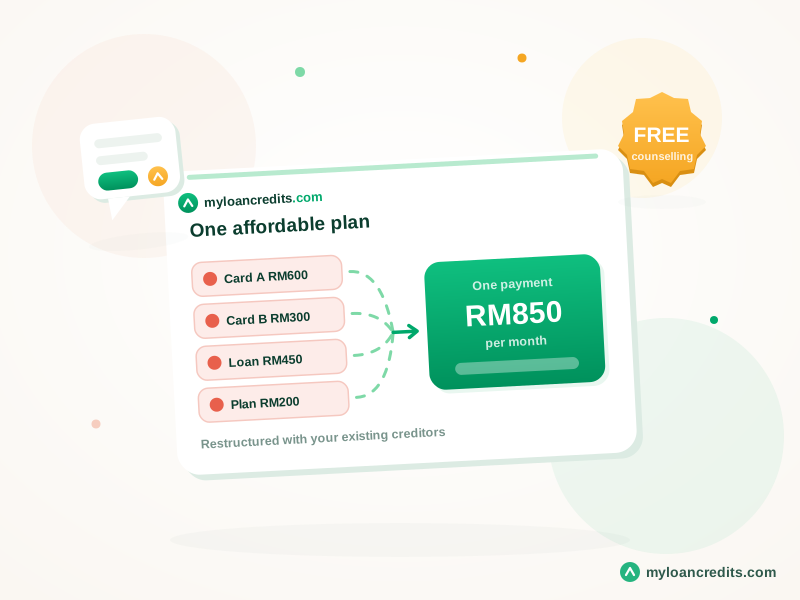
- AKPK proposes a restructured plan to your creditors. A single affordable monthly amount, distributed across the participating institutions, usually over a longer horizon and often with concessions on rate or charges.
- Creditors agree. Participation is at the institution's discretion, though the major Malaysian banks are long-standing participants.
- You pay one amount each month and AKPK handles the distribution, until the plan completes and you exit the programme.
The result is not debt forgiveness. You still repay what you owe. What changes is the shape of the repayment — one sustainable figure instead of several unaffordable ones, with the collection pressure lifted while you keep to the plan.
What it costs you
The programme is free, but it is not free of consequences, and anyone who tells you otherwise is selling something.
You cannot take new credit while you are on it. That is the point — the plan only works if the debt stops growing — but it means no new cards, no new loans, and no financing for a car or a home until you complete the programme.
Lenders can see it. Your participation is reflected in your CCRIS record while the plan is running, and lenders will factor it into any application after you exit.
It takes years, not months. A plan built around what you can genuinely afford is, by definition, a longer plan than your original terms.
Weigh those against the alternative honestly. Continuing to miss payments also shows up in CCRIS, also blocks new credit, and does so without a finish line, while late charges accumulate and collections escalate. A completed DMP is a repaired record. A drifting default is not.
Who it is for — and who it is not
The DMP fits when:
- Your monthly commitments exceed what your income can service, even after cutting back.
- You are missing payments, or paying one card with another.
- Your debts are with regulated institutions — banks, licensed moneylenders, and similar.
- You can commit to a plan and stop using credit for its duration.
It is not the right tool when:
- You can still meet a restructured instalment comfortably. In that case a consolidation loan usually costs less and leaves your borrowing capacity intact.
- Your debt is to an unlicensed lender. Illegal moneylending cannot be restructured through the DMP; that is a police report and a KPKT complaint, and our guide on ah long red flags sets out the steps.
- Bankruptcy proceedings are already underway, in which case you need legal advice rather than a repayment plan.
AKPK or a consolidation loan?
The two get confused constantly. They solve different problems:
| AKPK Debt Management Programme | Debt consolidation loan | |
|---|---|---|
| What it is | Restructuring with your existing creditors | A new loan that settles the old debts |
| Cost | Free | Interest on the new loan, plus any fees |
| Best when | You cannot meet current commitments | You can pay, but want one payment and a lower rate |
| New credit during it | Not permitted | Not restricted |
| Visible to lenders | Yes, while on the programme | Only as a normal loan |
| Needs approval from | Your creditors | A lender assessing your DSR |
The honest test is affordability. Work out your debt service ratio first. If a consolidated instalment would land somewhere you could actually sustain, consolidation is the lighter-touch option and keeps your record clean. If no realistic instalment fits — if the arithmetic simply does not close — then no lender should be approving you anyway, and AKPK is the route that helps rather than the one that adds.
How to get in touch
AKPK operates branches across Malaysia and offers counselling in person, by phone and online. Go through its official website, akpk.org.my, or an AKPK branch directly.
One warning worth repeating: AKPK charges individuals nothing. Any "debt settlement agent" offering to enrol you in AKPK for a fee, negotiate on your behalf, or "clear your CCRIS" is at best redundant and at worst a scam. You can approach AKPK yourself, and you should.
If borrowing is still the right tool
If you have worked through this and your situation is the manageable kind — commitments that are annoying rather than unpayable — then restructuring them into one loan may genuinely help. MyLoanCredits offers a personal loan from RM1,000 to RM100,000 over 6 to 60 months at 3.88%–12% p.a. on a reducing balance, with no early settlement penalty, and checking your options won't affect your credit score.
Before you decide either way, run your own numbers: our DSR guide shows you what a lender will see, and the debt consolidation guide works through a full ringgit example. If the numbers do not close, take that as the answer — and call AKPK instead. That is what it is there for.